Diamond face shape: features, comparisons and style ideas
Compare prominent cheek width with a narrower upper face and jaw, and find practical style options for a diamond profile.

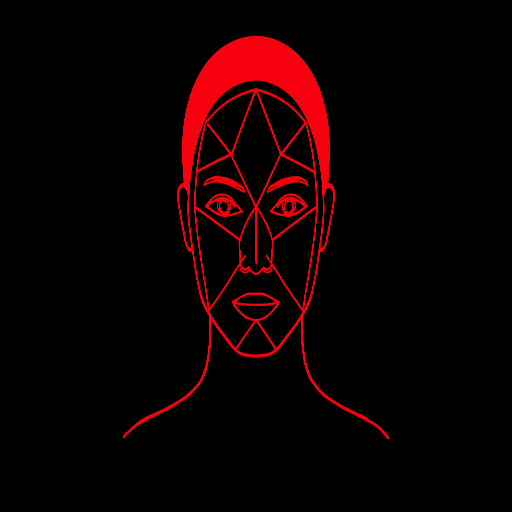
A diamond face-shape profile places the greatest visible emphasis at the cheekbones, with narrower upper and lower contours. The taper on both sides of the cheeks creates a more angular middle-focused silhouette, though many people overlap with oval or heart.
Three diamond face shape features to compare
Cheekbones dominate
The cheek span stands out more clearly than both the upper face and jaw.
Narrower temples
The outline draws inward above the cheekbones rather than staying broadly parallel.
Tapered lower face
The jaw narrows toward a defined chin without becoming the widest area.
How diamond face proportions usually read
Diamond is suggested when both temple or upper-face width and jaw width sit below cheek width. Because facial landmarks lie slightly inside the visible silhouette, the differences may be numerically small even when the shape looks distinct.
Before deciding from a photo
Strong side lighting can create cheek shadows that feel wider or sharper than the actual contour. Use even front light and check the edge of the face—not the highlight or shadow line.
Use the complete photo checklist →Diamond or Heart?
Diamond and heart both taper toward the chin. Diamond narrows again above the cheeks; heart tends to retain more width through the forehead or temple area.
Compare the detailed heart face shape guide.
The nearby Heart profile is usually described as: a heart profile carries more width through the upper face and tapers toward the jaw or chin. style choices can add presence lower down, soften the upper width, or celebrate the contrast.
Choose an effect, not a correction
Temple volume, a soft fringe or frames with an expressive upper edge can balance the cheek focus. Sleek styling can also emphasize the sculpted outline intentionally.
Prominent cheekbones alone do not prove a diamond shape. An oval face can also have defined cheeks while maintaining a broader upper face and gentler overall taper.
Hairstyle ideas for a diamond face shape
Soft fringe
A curtain, wispy, or side fringe with movement near the temples.
Visual effect: It adds gentle presence above prominent cheekbones.Chin-level texture
A bob or layered cut with soft fullness near the lower face.
Visual effect: Lower volume balances the cheek span and tapered jaw.Tucked waves
Waves that can sit behind one ear while staying loose on the other.
Visual effect: The asymmetry frames the cheekbones without widening both sides.Hair texture, density, growth direction, climate and maintenance can matter more than face shape. Take references with similar hair to a stylist and ask what the shape looks like without daily heat styling.
Glasses for a diamond face: fit before frame shape
Oval frame
A softly curved frame no wider than the cheekbone span.
Visual effect: It follows the central width without adding sharp corners.Gentle cat-eye
A slight lift with rounded rather than pointed outer edges.
Visual effect: Upper-corner detail adds presence near narrower temples.Light browline
A modest top rim with an airy or rimless lower section.
Visual effect: The upper emphasis balances cheekbone width without overcrowding it.A frame should remain comfortable at the bridge and temples, sit level and stay clear of the cheeks when you smile. Shape guidance cannot replace an optician’s fit or a prescription.
Beard and makeup options
Beard and facial hair
Keep some fullness below the jaw if you want to echo the cheekbone width. A gradual taper is easier to adjust than a sharp outline.
Keep controlled volume below the jaw and around the chin. Lower presence balances width concentrated at the cheeks.
Makeup placement
Place blush slightly above the cheekbone shadow and blend the edge. Emphasize or soften the cheeks according to your preference.
Place color on the high cheek and diffuse it rather than widening it. Controlled placement celebrates the cheek without adding a hard stripe.
Useful experiments
- Add controlled softness at the temples or lower face.
- Keep glasses within the cheekbone width and clear of the cheeks.
- Use asymmetry to frame rather than hide prominent cheekbones.
Pause and check
- Flat, tight sides if you want less emphasis on the widest cheek area.
- Frames that project far beyond the cheekbones.
- Heavy cheek contour that makes the central width more pronounced.
Questions people commonly ask
Is diamond really rare?
Reliable population estimates are not established here, so the site does not claim a verified rarest or most common shape.
Can a diamond face have a soft jaw?
Yes. The category describes width relationships; the edges can still look soft.
Why does my result switch to oval?
Small changes in temple width, lighting or head rotation can reduce the apparent cheek prominence. Compare both profiles rather than forcing a single label.
The descriptions explain this site’s transparent styling profiles. Content uses AI-assisted drafting and software-based checks against the implemented measurement rules; it is not an independent professional review. These are not clinical categories. Read the methodand accuracy limitations before interpreting an automatic result.
Ready to explore your own proportions?
Try the photo analyzer or use the manual calculator. Keep the result in perspective: your style is yours to choose.