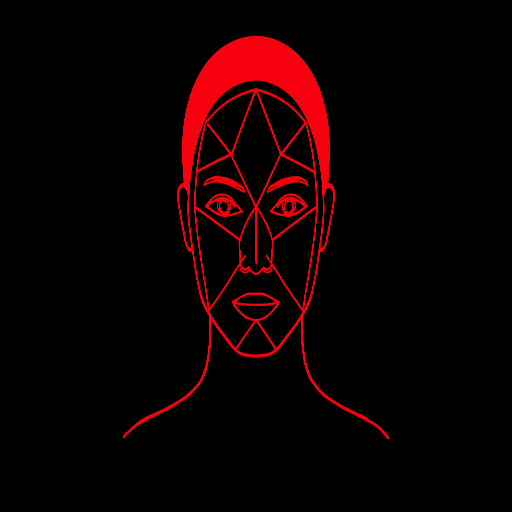
How face shape analysis works
From facial landmarks to a tentative styling profile: understand every step, check and limitation in the browser-based process.
Two different jobs: finding landmarks and interpreting an outline
The photo analyzer uses Google’s MediaPipe Face Landmarker to locate points on a face. It does not ask the model to identify you, judge your appearance, or predict a scientifically established face shape. A separate set of rules compares a few distances between those points.
Think of the landmarks as pencil marks on a portrait. They help us discuss the outline, but they cannot reveal the true three-dimensional size of your face from one photograph.
What happens when you choose a photo
- Your browser checks the file type and size, decodes it locally, and scales the working image to at most 1,400 pixels on its longest side.
- The browser downloads the model and its WebAssembly runtime from this website. Detection runs in a worker so the main interface can remain responsive.
- The tool checks for zero or multiple detected faces, a very small face, cropped landmarks, and obvious sideways or tilted poses.
- Four key spans estimate face length, upper-face width, cheekbone width, and lower-jaw width. Three additional temple and jaw-contour spans help separate profiles that otherwise cluster together. The image overlay keeps the four clearest measurements visible.
- Our photo heuristic compares six ratios against photo-specific profile centers, then suggests a styling profile. The manual tool keeps its separate, tape-measure-style rules.
- The photo is checked again with added border space and a mirrored view. All three outlines are mapped back to the original photo. Stable measurements are combined; inconsistent outlines prompt you to retake the photo.
The rules are visible, and their limits matter
A jaw wider than both the cheeks and upper face can suggest triangle; a broad upper face that narrows toward the jaw can suggest heart. Relatively prominent cheekbones can suggest diamond. Length helps separate compact, oval, and oblong outlines. The manual calculator also asks about jaw angularity to distinguish square from round.
These thresholds are implementation choices, not validated scientific cutoffs. The photo result presents the next profile when the comparison is close because the model does not reliably describe every aspect of jaw angularity, and its upper forehead landmark is not a hairline detector. It may suggest round where you would describe square, or oval where another photo suggests oblong.
What you get, and what you do not
You get ratios, ranked profile similarities, characteristics, a nearby category to compare, and detailed styling ideas directly on the page. You do not get physical measurements in centimeters, a validated accuracy percentage, an attractiveness score, or a diagnosis.
Read the measurement guide to check the numbers yourself, or compare the process with Google’s Face Landmarker documentation.
Ready to explore your own proportions?
Try the photo analyzer or use the manual calculator. Keep the result in perspective: your style is yours to choose.