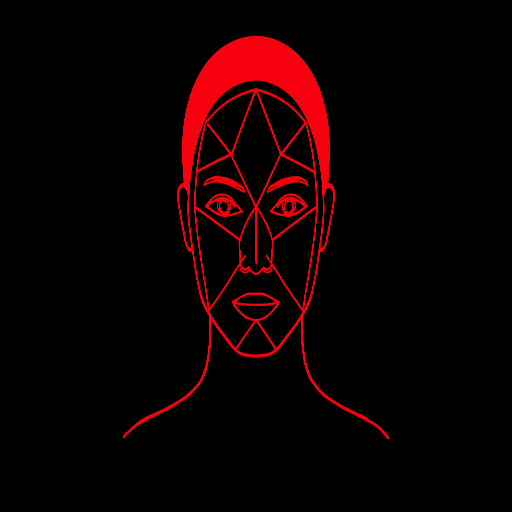
Heart vs diamond face shape: how to tell the difference
Compare heart and diamond face shapes by forehead, cheekbone and jaw width. Use a simple photo check, avoid hairline myths and handle a close result.
The short answer: if your upper face stays about as broad as your cheek area while the jaw narrows, heart may be the more useful description. If the cheekbones are clearly the widest point and the outline narrows both above and below them, diamond may fit better. A pointed chin can appear in either. Compare the whole outline in one level photo; a widow's peak is not a deciding test.
Heart vs diamond face shape at a glance
| What to compare | Heart tendency | Diamond tendency |
|---|---|---|
| Upper face beside cheeks | Upper face remains broad, often close to cheek width. | Upper face draws inward above clearly wider cheeks. |
| Widest visible zone | Upper face or an upper face and cheek area that are close. | Cheek area stands out from both the upper face and jaw. |
| Jaw and chin | Narrower lower face; chin can be pointed or softly tapered. | Narrower lower face; chin can also be pointed or softly tapered. |
| Widow's peak | May be present or absent. | May be present or absent. |
These are broad visual descriptions, not universal numerical definitions. Aclinician consensus on facial morphotypes also distinguishes cheek-dominant diamond outlines from broader-upper-face heart outlines. That study concerns aesthetic assessment in Asian populations; it does not validate a face-shape quiz or supply a cutoff for everyone.
A photo check you can repeat
1. Make the outline comparable
Use one front-facing photo taken with the lens around eye level and your head upright. Move hair away from the temples and cheeks, relax your expression, and keep both sides of the jaw visible. Stand back from the phone and crop afterward if needed. Very close portraits change apparent facial proportions through perspective; apublished camera-distance model shows the effect on facial features. Ourphoto checklist covers framing in more detail.
2. Record three widths from that same image
Measure straight across the visible upper face near the temples, across the broadest cheek area, and between the visible jaw corners. Call theseU, C, and J. Pixels, ruler marks, or any one consistent unit will work for comparing widths within the same photo. Do not mix a hairline-to-hairline tape measurement with a photo's temple span. The site’smeasurement guide explains why endpoints matter.
| Your photo | Upper face (U) | Cheeks (C) | Jaw (J) |
|---|---|---|---|
| Write one unit consistently | ______ | ______ | ______ |
If C is visibly greater than both U and J, and the sides draw inward above the cheekbones, the outline leans diamond. If U and C look close while J is narrower, it leans heart. Check the face edge, not a cheek highlight or a shadow. A difference of only a few pixels may come from where you placed the marks, so it need not decide the label.
3. Try the interpretation on numbers
Imagine a single photo with U = 112, C = 136, and J = 96 pixels. The cheeks lead the upper face by 24 pixels, and the jaw is narrower again: that is a diamond-like pattern. In a second hypothetical photo, U = 132, C = 136, and J = 96. The upper face and cheeks are almost tied, so heart or a heart-diamond overlap is a more useful description. These values only show how to compare three spans; they are not diagnostic thresholds.
Why the chin and hairline rarely settle it
Both profiles can taper to a narrow chin, so “I have a pointed chin” does not separate them. A widow's peak describes the hairline, not the width pattern below it. Bangs, a changing hairline, and the angle of a photo can make that clue even less dependable. Someone with a straight hairline can still have a heart-like outline; someone with a widow's peak can have cheek-dominant proportions.
If the forehead is covered, do not guess its width. Take a clearer photo or keep the answer open. Hair at the temples can make a broad upper face look narrow; side lighting can make the cheeks appear more sculpted without changing their outer edge.
What if the result is close or changes between photos?
First compare the input photos: camera height, head turn, crop, hair, and expression. Retake one level, well-lit portrait if the visible outline differs. If two good photos still place U and C close together, write down what you can actually see, such as “broad upper face, noticeable cheeks, narrow jaw.” That description can guide a haircut or frame choice without forcing a permanent category.
The photo analyzer uses Google'sFace Landmarker to locate image landmarks, then this site's own rules compare visible proportions. Its upper-face line is not a true hairline detector. A heart or diamond suggestion is a photo-based styling estimate, not a measurement of bone structure or a confidence percentage. Check the runner-up result and overlay, or use themanual calculator when the upper outline is hard for the model to read. Theaccuracy guide explains other reasons a result can shift.
Keep both labels when they both help
“Heart-like upper width with diamond-like cheeks” tells a stylist more than a disputed one-word result. Bring a clear photo and say which effect you want: more width near the temples, more movement near the jaw, or an emphasized cheek line.
Does the distinction change hair or glasses choices?
It changes which visual effect you might test. With a heart-like outline, a chin-length bob, lower-face texture, or a soft side fringe can bring attention toward the jaw; a sleek pulled-back cut can instead emphasize the upper outline. With a diamond-like outline, a fringe or volume near the temples can add presence above the cheeks, while a sleek style can make the cheek line the focal point. None is required. Texture, density, and upkeep matter more than a chart; use ourhairstyle guide to check those practical constraints.
For frames, first check bridge contact, temple pressure, lens depth, and cheek clearance on your own face. After fit, a heart-like upper face could try a lighter brow line or a frame that adds detail lower down. A diamond-like outline could try a stronger upper rim or upswept corners to echo the temples. You can also repeat rather than balance your natural lines. Our glasses fit guide gives a usable fitting checklist.
Common questions
Can a heart face have prominent cheekbones?
Yes. Compare those cheeks with the upper face. Heart-like proportions keep noticeable width high in the outline; a diamond-like pattern makes the cheek span the clear leader.
Can a diamond face have a widow's peak?
Yes. The hairline shape does not override the upper-face, cheek, and jaw relationship. Check the side contour above the cheeks instead.
Is diamond just a sharper version of heart?
No. Both can have a defined chin, but the useful comparison is where the outline becomes widest. You can have soft features with either width pattern.
This article compares familiar styling descriptions with this site's actual photo-analysis method. The example measurements and silhouettes are illustrative, not observations of real people. The linked clinician paper informs the broad width distinction in its specific study context; the camera paper supports the close-photo caution; Google documents landmark detection. For more detail on the site's rules, readhow the analyzer works.
Ready to explore your own proportions?
Try the photo analyzer or use the manual calculator. Keep the result in perspective: your style is yours to choose.